Author Archives: Bill Tucker

About Bill Tucker

Unknown's avatar
Jersey based and New York bred, Bill Tucker is an author of film reviews, short fiction and articles for variety of sites and subjects. He currently blogs for The Austinot (Austin lifestyle), the Entertainment Weekly Blogging Community (TV and film) and SkirmishFrogs.com (retro gaming). He's also contributed articles to Texas Highways magazine. His favorite pastimes include craft beer snobbery, gaming and annoying his friends with random quotes from The King of Comedy. You can check out all of his literary naughty bits at www.thesurrealityproject.com

The Lorax (2012)

Sing Song and Once-lers and Corporate Greed

This Flick Is As Shallow As A Ratty Old Thneed

The Notebook Doodle Lorax laments his own film adaptation.

The Notebook Doodle Lorax laments his own film adaptation.

Of all of the peeves I keep as pets, there are three that drive me up the wall.  Cotton balls, that dopey ZZ Top song currently playing on the office Spotify and the excuse, “Relax.  It’s only a kid’s movie.”

Sorry, John Q. Public.  In the immortal words of Jules Winnfield, “Allow me to retort.”

Films designed for youngsters too often get a pass from the critical community.  When we see sloppy writing, poor direction and hyper-caffeinated animation, we assume we’re too old to enjoy it.  The film is not for us.  When we like a kiddie flick, our comment is, “A children’s movie the whole family can enjoy”.  We’re surprised to find something Little and Big Johnny can enjoy in equal measure.  Such a novel breath of fresh air.  To that, I say balderdash.  Good movies are good movies, regardless of your age bracket and it doesn’t take someone with a drivers license to tell the difference.  Something tells me that even Jamie’s two year old nephew would stare blankly at the latest film adaptation of The Lorax and go back to playing with his trucks.  It may keep him from fussing for 85 minutes, but that’s about it.

First some background.  Penned late in the career of Dr. Seuss, The Lorax is one of the darker stories in the famed writers bibliography.  A cautionary tale of corporate greed and environmental responsibility, the 1971 book presents a world gone wrong and warns kids to not let it happen to them.  More of a fable than anything else, the power of The Lorax is in its ability to send a powerful message with a simple story and more importantly, respect the intelligence of young readers.  While director Chris Renaud (Despicable Me) is obviously a fan of the original, he looses sight of the book’s quiet power in favor of a big, noisy mess.

The saving grace of the film is the core material.  The central story of a boy visiting the mysterious Once-ler to learn about the demise of the Truffula trees are the best bits of the feature.  There are some genuine chuckles, the pacing is mostly spot on and you get a real sense of regret from the reclusive entrepreneur.  The important elements from the book are there, from the strange payment the boy has to make for an audience with the Once-ler to the ominous “Unless” rock outside his home.  The film also feels “Seuss-ian” in the animation and art design.  Even the principal voices, including Zac Efron as the young Ted, Danny DeVito as the titular Lorax and Ed Helms as the ambitious One-ler, all do acceptable if unimpressive work in their respective roles.
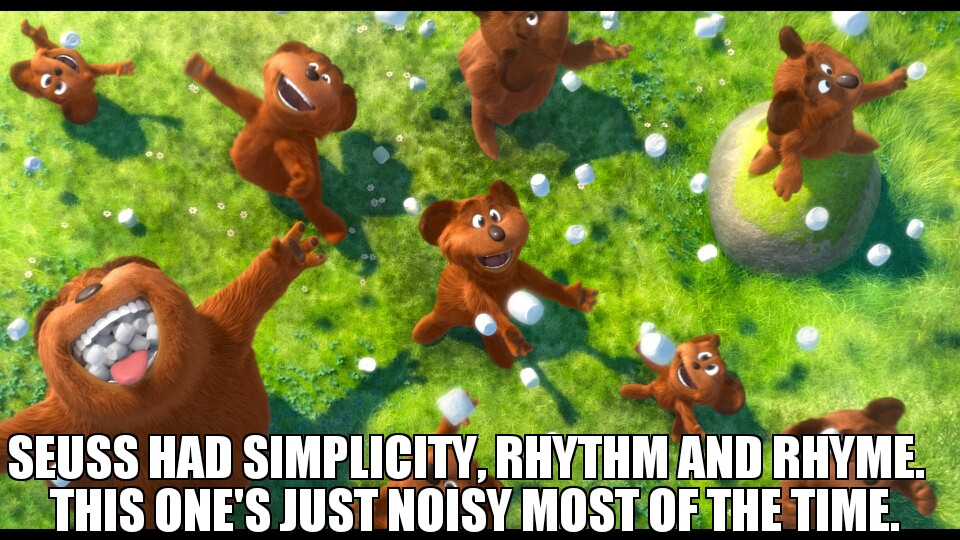
Lorax Meme

Sadly for film goers, the good bits take up a mere fifteen minutes of screen time.  The rest of the movie is exhausting, message muddling filler.  The first offense is the contrast heavy Thneedville, the mecca of commercialism and plastic trees our protagonists live in.  Not even Betty White can save the town scenes from devolving into eye straining visual noise.  If some films make their point with a hammer, The Lorax repeatedly beats you over the brains with a candy coated bulldozer.  We get it.  Nature is good, greed is bad.  No need to sing a horrific song about it.

The second major problem is with the young boy’s love interest, Audrey (Taylor Swift).  Shoehorned in solely to push the story along, this inclusion completely ruins the whole point of the story.  In the original, the unnamed boy is curious where the pretty trees went.  In this version, he wants to find one to impress a girl.  Boo, filmmakers.  Boo.

The rest of the feature is mired in Hollywood mediocrity.  It’s as if the producers were ticking off the “Kiddie Flick Checklist”.  The film’s called The Lorax, so forget the fact he’s a metaphor in the book.  We need the little guy to send the Once-ler down a raging river   Kids like sexless romance, so let’s hammer in a love interest.  Youngin’s can’t pay attention, so let’s throw in car chases, C grade Broadway show tunes and stinky jokes to keep them entertained.  After all, they’re just kids and this is a kids movie.  Right?

Wrong.  Kids aren’t stupid.  Dr. Seuss recognized this in 1937 when he wrote his first children’s book, And to Think I Saw it on Mulberry Street.  A child’s greatest asset is their imagination and the best films of the genre are those that enhance and nurture that creativity.  From the virtual sandbox of Toy Story to the magic of How To Train Your Dragon, children’s’ movies can do more than be electronic babysitters.  They can inspire as they entertain.  2012’s The Lorax does none of those things, creating the same ear splitting din we’ve been handed by Hollywood since computer animation became the norm, not a novelty.  Maybe I’d be kinder if I weren’t such a big fan of the good Doctor but something tells me the little nephew inside would still be snoring away.

Score – 40%

Insta-Piece – Smoke Curls Up From The Manhole

Where – Waiting For Jamie Outside 1411 Broadway

Drip drop rain-plops spit from the grey sky, 6:46 PM on a gloomy Tuesday. The world buzzes out and around like ants from a colony, all with purpose, whether they know it or not. A series of ones and zeroes all connected yet independent in the great program of right now.

Smoke pours from the manhole cover on 41st and Broadway. The mist filters out the neon blare of Times Square billboards and tourist-centric distraction. The smoke is a friend, a reminder of Scorcese’s NYC: Taxi Driver, Mean Streets, After Hours. 1970’s sex, drugs and decadence. The time of Cesear with more trannies.

The smoke has left and the glare pushes through but I wish that mist would return, the movie in my head playing over and over with a Miles Davis song cooing on the soundtrack. Wet sound of cabs screaming southbound, the damp footfalls of shoes on pavement, the smell of food truck meat simmering on open griddles. The scene is set as the colony slithers and stretches into the foggy night. And my minds wanders off to scenes yet filmed.


Searching For Sugar Man (2012)

The Story of the Search for South Africa’s Adopted Son

Searching For Sugar Man

Take a look-see at the nominees for Best Documentary from this past year.  They include AIDS epidemics, the Israeli secret service, familial turmoil in the West Bank and the cover-up of rape victims in the US military.  Difficult subjects of depth, intrigue and emotional weight.  So who ended up taking home the trophy?  A movie about the mysteriously short career of a Detroit based musician.  While the film ducked under the same radar as its subject, a viewing will prove the Academy made the right choice this year.  Searching For Sugar Man is a profoundly human story full of mystery, surprise and some of the best music you’ve likely never heard before.

Ever hear of a seventies era folk rocker named Rodriguez?  Just Rodriguez?  Before Searching For Sugar Man, neither did I.  This Swedish doc explores the extraordinarily brief career of the Detroit based singer/songwriter.  In the Motor City, he cut a pair of records, released them to a public ripe for his Dylan-esqe protest sound and sold about ten copies before fading into obscurity. So why didn’t he hit it big during an era of unrest?  How come his biggest fan base resided a continent away?  Why did he disappear into the ether, leaving behind fractured stories of his suicide?  The answers to these questions are most of the fun in this doc, full of twists, turns and redemption

Searching Two

Right off the bat, the music is placed front and center throughout the film and for good reason.  Even with only a sampling of songs, the craftsmanship and tenacity of the recordings are astounding.  Socially conscious folk with a revolutionary edge, the music of Rodriguez catches your ear and never lets go.  In fact, the opening thirty minutes of the movie almost comes off as a strange episode of VH1’s Behind The Music but as the mystery unravels, you get sucked into the personal story of this mysterious artist.  As the cliché goes, sometimes the truth is stranger than fiction.

It also doesn’t hurt the film is beautifully photographed, using a combination of 8 mm film, animation and an iPhone app after director Malik Bendjelloul ran out of money.  From the gritty exteriors of Detroit to the streets of South Africa, Searching For Sugar Man is well framed and for the most part, well paced.  The only low points are some obvious filler between the opening and the central reveal but when the movie hits its stride around the fifty minute mark, it never looks back.  You can also make the argument the director really pushes his subjects to amplify the drama, but all that is forgivable given the care he gives the mysterious guitarist.

Filmed on a shoestring budget, simply for the love of the material, Searching For Sugar Man is a touching and empathetic piece of filmmaking.  With a fascinating and exceptional central subject, the movie becomes a celebration of talent and beauty in a year full of bitterness and pain.  While the doc may not pack the punch of the other nominees, I walked away happy to have met somebody so quietly wonderful, both behind the guitar and in everyday life.   A lovely film about an extraordinary person.

Score – 90%


Aladdin (1992)

Originally Reviewed – 9/13/2012

Before I take a look at my latest Review My Collection installment, let’s take a trip to early nineties. Disney was the toast of the animated world with a series of films I call “The Disney Four”. In order, the big D sent The Little Mermaid (1989), Beauty and the Beast (1991), the subject of this review and The Lion King (1994) to theaters and each film is regarded by many to be classics (with exception of Mermaid, but that’s a conversation for another day). Aladdin was the third film in The Disney Four and while it doesn’t reach the heights of the one that came before or after, it’s a solidly entertaining piece of animation that still holds up in modern day viewings.

Framed in the setting of Arabian sultans and princess, Aladdin is the story of a young street urchin, a persnickety princess and a wisecracking genie. Aladdin and his faithful primate Abu are having a grand old time in Agrabah. Ducking guards, stealing apples and singing showtunes, life is rough but free-wheeling for the pair of pals. On the other side of the palace wall sits Princess Jasmine, a privileged yet imprisoned aristocrat who bemoans her station in life, especially the parade of potential husbands who come a-courting. According to law, she has to marry a prince but none of them spark the flame of independence that’s smoldering inside her. Further complicating matters is the nefarious, pencil mustached advisor Jafar who looks to gain political advantage from Jasmine’s indecision. How you ask? An ordinary lamp containing the cartoon embodiment of Robin Williams.

From the outset, everything seems in place for an early nineties Disney movie. Toe tapping tunes? Check. An off center setting that leaves plenty of room for creative license? Check. A romance that supports the underlying theme of acceptance despite cultural and sociological differences? Double check. Aladdin is an easily likeable protagonist, his monkey buddy provides some physical comedy and the villain, alongside the voice of Gilbert Godfrey as his parrot sidekick Iago, is evil enough to give the feature some genuine tension. The pieces all work to provide a very enjoyable if inoffensive joyride through the Arabian nights.

The real star of the film is Robin Williams as the free wheeling Genie. While I’m not the biggest fan of the comedian, he’s a fine actor and lifts the film with some genuine laughs. Most of the characters in Aladdin can be kindly described as vanilla but Williams, with a nice combination of improv and good writing, gives the movie a jolt of energy. Unfortunately, Disney was still in that strange period where female protagonists were still stuck in the castle tower. This is prevalent here with Jasmine, a vapid and almost annoying character who whines her way through the feature. If it weren’t for the great music and the likeability of Aladdin balancing out the privileged princess, the twosome may have sunk the entire feature.

Luckily, this not the case. While not on the level of either Beauty and the Beast or the best film in the foursome, The Lion King, Aladdin satisfies its intended audience with great animation, exciting action and the requisite love story Disney fans crave. Mostly by the numbers in terms of storytelling and characters, the over the top Genie gives the feature a distinct flavor that stills holds up today. A fun filled adventure for all ages.

Score – 80%


A Beautiful Mind (2001)

Originally Reviewed – 9/2/2010

When the phrase “Oscar nominated actor” comes up, Russell Crowe isn’t the first name that springs to mind. But in a three year span from 1999 to 2001, the New Zealand born actor was the most decorated performer in Hollywood. The Insider gave him his first Oscar nomination for Best Actor, the new millennium saw him win the award for his starring role in Gladiator and one year later, he completed the nomination trifecta with his brilliant portrayal of mathematician John Nash in Ron Howard’s A Beautiful Mind. While many critics derided the film for its lack of historical accuracy, the fine acting, excellent script and heart-wrenching story makes it a success on nearly every level.

The film centers around the sorta-true life story of mathematician John Nash. The script follows Nash as he progresses from an eccentric Princeton graduate student searching for an original idea to his work with the government cracking codes. He’s got a girl, a gig and limitless potential. All seems well in the life of the genius until the world he believes to be true comes crashing down around him. If I seem hesitant to do a plot synopsis, there’s good reason for that. Much of the film’s tension lies in a mid movie reveal that turns the entire story on its head. Suffice to say, this is a film that must be watched twice if only to capture the little hints and nods to the second act twist. Much of the film’s success lies in its ability to surprise, a rarity in the usual staid biopic genre.

But the movie isn’t all shocking reveals and plot twists. The core of the experience lies in the very realistic love story between Nash and his wife Alicia (Jennifer Connelly). Taking home a well deserved Best Actress Oscar for the role, Connelly is brilliant as the romantic interest. Rather than hot passion, Connelly’s character serves as Nash’s support system through the tough times in his life. The film is a bit of a brain bender and the choice to soften the experience with a genuine love story is a smart and effective one.

Naturally, when doing a film of this nature the toughest task goes to the lead. The line between parody and impersonation is a fine tightrope. Teeter either way and the film falls apart. Russell Crowe avoids this by balancing the mannerisms of the real John Nash with some strong character work, allowing him to absolutely disappear in the role. The Oscar winning makeup certainly helps in creating the illusion but it would just be fancy latex without the great acting by Crowe. The rest of the cast perfectly complements the principals, including fine work by Paul Bettany as Nash’s friend Charles and the always reliable Ed Harris as Department of Defense agent William Parcher.

The main detraction most reviewers found with this movie in the large historical inaccuracies between the real life John Nash and the fictitious character. Remember all that talk about the realistic love story and his Fascism defeating code cracking? Fictitious. Biopics generally pride themselves in presenting their subjects in a realistic light, but A Beautiful Mind takes great liberties with the true story of John Nash. While purists may find these revisions almost offensive, I found the film conveyed the nature of his struggles in a visual and artful way, even if the specifics are largely manufactured. Think of it as sacrificing accuracy for the greater emotional good. If you want to learn about the real John Nash, rent the excellent PBS documentary A Beautiful Madness.

While many of the film’s elements were invented to enhance the drama, the drama itself is excellent and well worth a watch. The movie theater is where I go to get swept away and in that respect, A Beautiful Mind does just that. Combining a fantastic ensemble cast, some amazing effects and more surprises than one would expect from a “standard biopic”, Ron Howard’s portrait of a burdened genius stirs the soul with a powerful yet hopeful message of triumph in the face of adversity. Winner of four Academy awards including Best Picture, A Beautiful Mind may not be 100% accurate in its storytelling but it captures the spirit of an inspirational person better than any biopic could ever hope for.

Score – 90%


The Dark Knight Rises (2012)

Originally Reviewed – 8/12/2012

As much as I love a silly Wes Anderson flick in the middle of summer blockbuster mayhem, eventually the Batman comes knocking.

This summer, there’s no escaping the Caped Crusader. After a successful first installment and its game changing sequel, Christopher Nolan’s Dark Knight trilogy has reached mass awareness, reminding me of that fateful Summer of the Bat from 23 years ago. Much like the original 1989 feature, even if you don’t know a thing about the Man in Black, you know about this film. Online, on TV and around the water cooler, anticipation and expectations have been sky high. Could the film possibly best the standard set by its predecessor? Probably not. The second act is always the most interesting part of any story and the new Batman franchise is no exception. But is it a good ending to the story? Absolutely. Not only is The Dark Knight Rises a near perfect finale to the greatest superhero series ever put to film, it’s an expertly made and thoroughly satisfying piece of pop cinema.

Where Begins told the origin story and The Dark Knight cemented Batman as an anti-hero, this film starts on a very different tone. Taking place eight years after film number two, things have never been better in Gotham City. Crime is at an all time low and while the rest of the city basks in their newfound safety, Bruce Wayne has nothing to do but be a Howard Hughes style recluse. Remember it’s been four real years since we’ve seen Bruce Wayne on the silver screen, so to see him as a hobbling hermit is a shocking reintroduction to the classic character. The opening Bane / plane dropping set piece is only the action prelude the producers and fanboys crave. The real beginning is Bruce Wayne with a cane and this sets the tone for a slow but very important opening third of the film.

In fact, the opening of Rises makes one thing very clear. This is NOT a Batman movie. Begins was Batman’s origin story, important in getting the Schumacher taste out of our mouths. The second was Batman doing Batman things against Batman villains. Joker was the driving force and to combat him, Batman had to be the Batman we all remember from countless movies and comics. The latest film is most certainly a Bruce Wayne movie. Nolan realizes that Batman is just the by-product of Bruce Wayne’s scarred psyche and instead of rehashing the previous movies, takes the dangerous route of resolving a character we’ve never seen fully resolved in any Batman media. This gives Christian Bale free reign to give his finest performance in the series. It was a risk but the slow build of the opening 45 minutes paves the way for an interesting and satisfying resolution of Bruce Wayne and by association, the Batman character.

Of course, this isn’t Masterpiece Theater we’re talking about. There are still plenty of eye popping set pieces that look glorious, especially in IMAX. Many of the good bits have been spoiled in the trailers, but it matters little when seen on the big screen. My only gripe with the action is that it has very little of the Batman flavor to it. Where The Dark Knight had aerial stunts and hand to hand ass whooping, the action in Rises is limited mostly to car chases and a giant airborne machine called “The Bat”. The action has a mechanical feel to it and while Batman does square off in the usual “two guys attack while the rest wait their turn” style, the result seems watered down. While it all makes thematic sense, the action seems less visceral than the previous films. Also troubling is Nolan’s uninspired vision and design of Gotham City. Let’s face it. Gotham is any big city in America and instead of the heightened visuals of the Burton features, Nolan’s Gotham is drab, boring and uninteresting.

But there’s more to Batman than cowls, gadgets and that tank he cruises around in. Batman has always been as good as the people around him and the supporting cast of Rises works in varying degrees. As I’ve said in previous reviews, Christopher Nolan is all about theme and the periphery characters in Rises all do a fine job in supporting that theme and moving the story along. The main villain is Bane (Tom Hardy), a mask wearing terror monger who threatens Gotham. While not on the level of The Joker, Bane is a perfectly suitable villain, even if you can’t understand half of what he’s saying. To further complicate Batman’s life is the mysterious jewel thief Selena Kyle (Anne Hathaway). Hathaway does a very nice job in the Cat Suit, despite her character having little development in the script. In fact, every outside character has little reason to be there except to the serve the story. From Joseph Gordon-Levitt’s “always there in the nick of time” do-gooder cop to Marion Cotillard’s environmental activist, the actors all do well in the roles given, but they never seems like real people. More like pawns moving the story to an incredibly satisfying conclusion, the supporting cast of Rises never gets more than lines to say, making the obligatory alliances and romantic collusions come off forced and unbelievable.

In thinking back on this film, I’m reminded of a conversation I had with my uncle. After seeing this movie, he put together a laundry list of things that didn’t work or make sense and e-mailed them to a big time Batman fan. His friend’s answer to each complaint? “It’s Batman.” To me, that’s a cop out, much like when defenders of the Star Wars prequels shrug and say, “It’s the work of The Force”. The answers to a films giant plot holes can’t be resolved by a mystical macguffin. It’s just the result of sloppy writing. But when I think back to my experience with The Dark Knight Rises, my complaints can be answered in a similar way: “Who cares.” Despite my nagging issues with the final stanza in the Nolan Batman series, the result is still an entertaining and fascinating finale to the greatest superhero series ever made. Even with the sugar coated ending, I left the theater smiling, fully satisfied with a well told, well acted story. It may not be the revelation The Dark Knight was, but Rises is a fantastic ending to an epic saga.

Score – 85%


Moonrise Kingdom (2012)

Originally Reviewed – 8/1/2012

The evening I saw the latest film from director Wes Anderson was a chaotic one. New York is normally a swirling den of noise and nonsense but this particular day was madness. The subway to work was crowded, the bus home was worse and when 6:00 rolled around, my mind was spinning. My plan for that evening was to see a movie, get back in the groove of weekly viewings and reviews. The Dark Knight would have been an obvious choice but I couldn’t handle more noise, regardless of the good reviews and the thousands of people standing outside the AMC on 34th St. My solution? A quirky and quiet film made by the director of Rushmore, The Royal Tenenbaums and the Fantastic Mr. Fox. My decision to eschew the bombast of the blockbusters proved to be a good one. Not only is Wes Anderson’s Moonrise Kingdom one of the finest films the director has ever made, it’s one of the best movies of the year and should be a slam dunk addition to my Best of 2012 list come December.

The world of Moonrise Kingdom is set on the idyllic New England island of New Penzance. Here we meet the usual cast of quirky Wes Anderson characters: a local policeman (Bruce Willis), a troop of Khaki Scouts headed by the no nonsense Scout Master Ward (Edward Norton) and the Bishop family including lawyers Walt (Bill Murray), Laura (Frances McDormand) and their four children. Like many of Anderson’s early films, these characters are complex, interesting and charmingly off center. Anderson excels at creating surreal worlds that are familiar enough for audiences to relate to but just foreign enough to give them their own flavor. Moonrise Kingdom is the best example of this dichotomy since Rushmore and as a result, shines the brightest among the director most recent efforts.

The central drive of the story is one of love in the face of all odds, a common theme in a Wes Anderson picture. This time around it’s the awkward yet endearing joining of two young people, Suzy (Kara Hayward), the book obsessed eldest daughter of the Bishop family and Sam Shakusky (Jared Gilman), a runaway Khaki Scout. Together, they go on an adventure that ruffles the feathers of the entire town. The pair travels over trails, dances awkwardly and shares moments over their beach swept campsite. Anderson has an uncanny knack for making his underage stars more adult than the grownups, and Moonrise Kingdom does a wonderful job doing just that. One could make the argument that the further Anderson has strayed from having children at the center of his films, the worse they have become. Luckily for long time fans, Moonrise Kingdom has no such issue as the film’s stars do most of the heavy lifting and pull it off beautifully.

The film is also one of the best looking movies the director has ever produced. Each shot is meticulously framed and executed, all with Anderson’s signature slant. The cinematography reminds the audience of reading a picture book in the way they’re presented and further lends authenticity to the lighthearted yet emotionally involving story. The comedy is perfectly balanced with the drama, and everything is fine tuned to a near perfect shine. I didn’t even mind the strange cadence the cast spoke in. While sometimes it was hard to make out what exactly they were saying, it further enhanced the mood of the island being a familiar yet very different place.

If you’re like me, you get wrapped up in movies. The bad ones may itch like Grandma’s sweater but the good ones soften your heart like a warm Snuggie. Regardless of the feel, I’m the type of person that likes to get entwined in the story on screen. After watching Moonrise Kingdom, my walk home in the madhouse city seemed a little lighter and easier to bear. Wes Anderson’s latest film may be one of his more accessible features but that doesn’t mean it’s any less like curling up with a good fairytale next to a roaring bonfire. Featuring a great story, simple yet involving performances and a sense of joy I haven’t felt since last year’s Hugo, Moonrise Kingdom is a triumphant combination of style and cinema. Destined to rank as one of my favorite film of the year, Wes Anderson’s latest movie is a return to form that fans, causal and hardcore alike, cannot afford to miss out on.

Score – 100%


The Dark Knight (2008)

Originally Reviewed – 7/21/2012

When Batman Begins hit theaters, it was a revelation. Dark, gritty and visceral, the Caped Crusader had made a grand return to the silver screen and fans like me loved it. As soon as the credits rolled on the initial film in the Nolan trilogy, I wanted more. The only reservation I had was in the movie’s final frame, the one where the sequel’s villain was revealed. Joker. I remember thinking how could they possibly do another Joker. Jack Nicholson was Joker and even if they found a suitable replacement, how could Batman theatrically stand up to such a strong character. My fears, as everybody on the face of the planet knows by now, were unfounded. Not only did The Dark Knight exceed the original film in storytelling, action and grandeur, it’s one of the finest superhero movies ever made. In fact, in re-watching it for what seems like the 1000th time for this review, I hesitate to call it a superhero movie at all.

Much like the first movie in the new series, The Dark Knight revolves around a central theme. This time around, it’s idea of anarchy balancing order. Much like the ying and the yang, one cannot exist without the other. And what better way to illustrate that point? Have a maniacal clown (Heath Ledger) spin chaos in the streets of Gotham. Hot on his tail is the new district attorney, Harvey Dent (Aaron Eckhart), Lieutenant Jim Gordon (Gary Oldman) and the Man in Black himself (Christian Bale). Everything in the second film is bigger and more grandiose than it was in the original. The action is better paced, the role of Rachel Dawes was replaced by a better actress (Maggie Gyllenhaal) and there even more Lucius Fox (Morgan Freeman). And let’s be honest. More Morgan Freeman is always a good thing.

Bale once again cements himself as this generation’s Batman, even though his character has less of an impact than he did in Begins. Batman is still an easy character to root for but the story of TDK runs into the classic, “the villain is more interesting” trap. Heath Ledger’s Joker, a role he won a posthumous Academy Award for, is fascinating and terrifying. While many fans latched onto the Nicholson / Ledger debate, I remain Switzerland in my opinions. The two did very different interpretations of the character, making a side by side comparison near impossible. Nicholson’s Joker was more fun, Ledger’s was more controlled and interesting, thanks to a fantastic script by David S. Goyer. In the end, Ledger’s Joker stole nearly every scene he while it does come off a little over the top at points, it’s the Joker. He’s allowed to be a little unhinged.

The rest of the cast follows the exact same beats, thanks to the fine direction of Christopher Nolan. The film is visually spectacular, with more involving action sequences, clever nods to the first film and the further development of the Batman character. This time around, the hero doesn’t always triumph and like any good “second act” movie should do, sets a dank and almost depressing tone for the third installment. Nolan’s direction is much more focused this time around but the screenplay is so jam packed, the film feels much longer than its 152 minutes. Other minor issues include pacing problems in the third act and a Dawes / Wayne / Dent triangle that provide little tension but when my internal critic starts yammering, there’s another jaw dropping set piece to shut it up.

At this point in the review, I have little else to say that hasn’t already been said. The new film opened this weekend, critics are going nuts for it and releasing a Dark Knight critique may be like throwing a coconut into a pack of feeding animals. I doubt they’d have any interest. Much like the final image of Batman riding into the night, The Dark Knight is all about looking forward to the final feature, a film that would take 4 years to eventually reach us. It stands alone as one of the best superhero movies ever made, but the film’s real success is going to depend on how well the Jedi of the trilogy maintains that momentum. As is, The Dark Knight is a gripping, fun filled and chaotic ride that gives us more insight into the Man in Black than any other feature to date. Batman’s second modern day adventure is the archetype for modern superhero movies, giving the most cinematic comic character in existence the series he deserves. The third and final movie awaits and I doubt it will disappoint.

Score – 90%


Batman Begins (2005)

Originally Reviewed – 7/9/2012

Ten years after the critical and commercial failure that was Batman and Robin, Warner Bros. handed over the shattered franchise to writer Davis S. Goyer (Blade) and relatively unknown English director Christopher Nolan. Known mostly for psychological thrillers like the impressive Memento and Insomnia, Nolan had critical cred but had never helmed a large production. Undaunted, Nolan sought to return the franchise to the darker, more personal tone of the original comic book vision. The result is a return to form for the Caped Crusader and while the film isn’t without fault and missteps, anything was going to be better than the Schumacher disaster. Seriously. Anything.

Doing what no film had successfully done before, Batman Begins is the true origin story of the Dark Knight. Starting with the death of his parents to his self imposed exile into the dregs of criminality, Bruce Wayne isn’t the smiling billionaire every other Batman film painted him to be. Wild, manic and out of control, Wayne finds direction in the tutelage of Ducard (Liam Neeson), a member of the League of Shadows. Here, Wayne hones his natural abilities and learns the ways of the ninja, a precursor to the crime fighting techniques inherent in the comic book Batman character. This sequence, which comprises of about 45 minutes of screen time, is interesting as an explanation of Batman’s skill set but doesn’t feel like a true Batman movie. As a result, the tone of the movie shifts in sometimes jarring ways as the movie transitions from the kung fu setup of the first third to familiar Gotham in the second.

Here is where we get a well rounded and more familiar Bruce Wayne. The setups of how he comes about his gear and gadgets are some of the best bits of the film, buoyed by the great work of Morgan Freeman as Wayne Enterprises scientist, Lucius Fox. Rather than the standard “super villain makes a mess” approach, Nolan’s Gotham is overrun by the mob, headed up by gangster Carmine Falcone (Tom Wilkinson). Of course, this wouldn’t be a Batman film without over the top villainy but here is where the film makes its biggest misstep. The bad guys include a mad psychologist who calls himself Scarecrow (Cillian Murphy) and the mysterious Ra’s al Ghul. Scarecrow has the potential to be an entertaining and interesting villain but his limited screen time weakens the potential of the character. Ra’s al Ghul has the opposite problem. Despite many minutes of developments and plot twists, the character doesn’t do much of anything other than shout orders and exposition. For the first time in the film history of Batman, the villains take a back seat to the Dark Knight and while the character of Batman is helped greatly by this shift, the clashes lose something in the change.

That said, everything in the film sticks to the main theme, something that Nolan has done well as a filmmaker, sometimes to a fault. Underlying idea of becoming your fear in order to conquer it is well established and makes for an interesting experience. Luckily for Joe Shmoe filmgoers, there’s some fine action as well, highlighted by a heart stopping chase sequence in which Batman pilots a high speed tank called the Tumbler through the streets and rooftops of Gotham City. The hand to hand combat, a staple of the Batman character, is visceral yet flawed due to some ill advised “shaky cam” that pushes the envelope so far, I felt the need for a dose of Dramamine to counteract the effects.

Anyone who hasn’t seen this film is wondering one thing. How did Christian Bale do as the title character. Simply put, Bale’s Batman ranks second only to Michael Keaton’s original interpretation. Before fans of the new series label me as an old “fuddy duddy”, let me explain. Keaton’s Batman was the perfect expression of the duality of Batman. Bumbling billionaire by day, ass kicking vigilante by night, Keaton expressed the two sides of the character almost perfectly. Bale’s Batman does a great job of being “on theme” with the movie, but I found his “Back in Gotham” Bruce Wayne to be too cool and over the top. In this most recent viewing, I realized exactly by Bruce overcompensated when he’s not in the cowl and cape, but it doesn’t make the experience that less jarring. I will say that Christian Bale is easily the most electrifying action Batman, using his full physique to intimidate thugs and battle baddies. And no, I’m not going to make fun of Bale’s “Batman voice.” Despite how many jokes have been made at his expense, it works given the context of his training and approach to dealing justice.

When you boil it down to the prime components, Batman Begins is a true return to form for DC’s flagship franchise. Batman has always been the most cinematic of all comic book characters and Nolan’s dark, gritty and realistic depiction works as both fan service and a modern cinema hero. The essence of Batman is the story of a man trying to live up to his father’s legacy while conquering his own fears and Christopher Nolan captures this nicely in his first stab at the classic character. Despite some pacing issues and a pair of lackluster villains, Batman Begins hits on both the action and drama fronts, setting the table nicely for a new series for a new generation. Schumacher’s stain on the Batman name was forgotten forever once this film came out in the summer of 2005. And you know the best thing about this movie? Without it, we wouldn’t have the sequel, 2008’s The Dark Knight. Worth every minute just for that.

Score – 80%


Prometheus (2012)

Originally Reviewed – 7/3/2012

Ever since Prometheus was released in North America on June 8th, there’s been a swarm of conflicting opinions. Some hail the movie as an intelligent return to true science fiction and others call it a twisting, turning mess that asks a ton of questions with very few answers. Some moviegoers have gone so far to say it’s as bad as the Phantom Menace and a disgrace to the Alien franchise it may or may not be rebooting. From my perspective, these people are expecting way too much from Ridley Scott’s return to the sci-fi genre. Prometheus is an exquisitely made film full of excitement and intrigue, despite some story pitfalls and mistakes that have left many a fanboy weeping in their Cheerios.

The tale revolves around two archeologists, Elizabeth Shaw (Noomi Rapace) and Charlie Holloway (Logan Marshall-Green) who discover repeated circle patterns in remote cave paintings. There’s only one galaxy in the known universe where the planets are arranged in the exact same fashion, so what do they do? Get the backing of a major corporation and take a team of scientists on a 2 year journey to the remote cluster of planets. While traveling in hibernation, the ship is run by David (Michael Fassbender), a humanoid robot thing that watches films, plays bicycle basketball and reads the sleeping crew’s dreams. At the end of the journey, the team wakes up to find themselves two years older and ready to embark on a unique expedition. Their goal? Nobody knows.

From the opening image of the film, Prometheus takes great pains to ask a number of questions. These quandaries revolve around the nature of creation, humanities place in the universe and the never ending search for truth. These themes are fascinating and bring you deeper into the mystery of the crew and the strange planet they find themselves on. As a couple of reviewers have said, Prometheus is a true science fiction film. Not sci-fi-fantasy-action or a dramadey set in space. This is sci-fi at its most genuine, a genre that’s always been about the search for answers beyond our world and abstractions of our basic reality. While the movie doesn’t end on the most satisfying note (more on that later), the ride it takes is one of fascinating intrigue.

Of course, some beautiful visuals help things along. Cinematographer Dariusz Wolski graces the screen with an alien world that looks natural and real. Everything in the film looks as though it was plucked from an alien archive. The technology all makes sense, the far off vistas are immaculate and the entire film is coated with a polish that’s hard to deride. Scott also uses the beautiful setting to create some genuine tension and fear for the well chosen cast. Michael Fassbender is the true star of the film, creating an unreliable character that is likable and terrifying in equal measure. Rapace is well suited to play the female scientist, despite her spending much of the film screaming and quivering, as should be expected in a Ridley Scott directed alien movie. The rest of the cast ranges from perfectly suitable (Marshall-Green as the other scientist) to downright horrendous (Charlize Theron in a role that had no reason to even exist). Idris Elba also deserves some special praise as the ship’s captain, the only one of the quickly assembled crew of side characters to ever develop beyond simple alien food.

But if you put your ear to the wind and listen closely, you’ll still hear the whisper of science fiction fans yelling in the distance. These gripes, while excessive, are not completely unfounded. Like I mentioned earlier, the movie takes great pains to ask hard questions while never once providing concrete answers. While the nature of the film makes this palatable, what doesn’t work is the ham-fisted ending that has many sci-fi geeks flooding message boards with immutable rage. The film takes great pains to develop real tension and pacing in its first ninety minutes. The scenery is realistic, the action is well done and everything seems to building towards something. Anything. All well and good until the film spirals out of control in the final half hour. What started as a carefully paced movie with moments of terror and suspense, rockets to its conclusion in a flash of explosions, head scratching reveals and obvious fan service. None of it is terrible, but it’s disappointing to have such good pacing ruined by what looks like a hacked up script. In fact, I wouldn’t be surprised to learn that the studio stepped in during script approval and demanded it be cut to a trim two hours. It’s either that or the screenwriter (Damon Lindelof of Lost fame) did what he does best: create spine tingling intrigue only to ruin it by simply making things up as he goes along.

Despite some questionable character choices, baffling turns and an ending that moves so fast it kicks up Road Runner dust, Prometheus is an impeccably crafted and thoroughly entertaining science fiction film. Filled with intense action, moments of terror and some clever winks to the Alien franchise faithful, Prometheus will satisfy viewers who go in with tempered expectations. While this isn’t the sci-fi messiah super fans were hoping it would be, it’s still a damn good film and one of the best times you can have in theaters thus far this season. And, let’s be fair. In a summer full of shoddy Adam Sandler comedies and vampire slaying presidents, being a well made film that delivers in nearly all the ways that really matter should be more than enough for the average moviegoer.

Score – 85%